
Mastering Careers & Skills
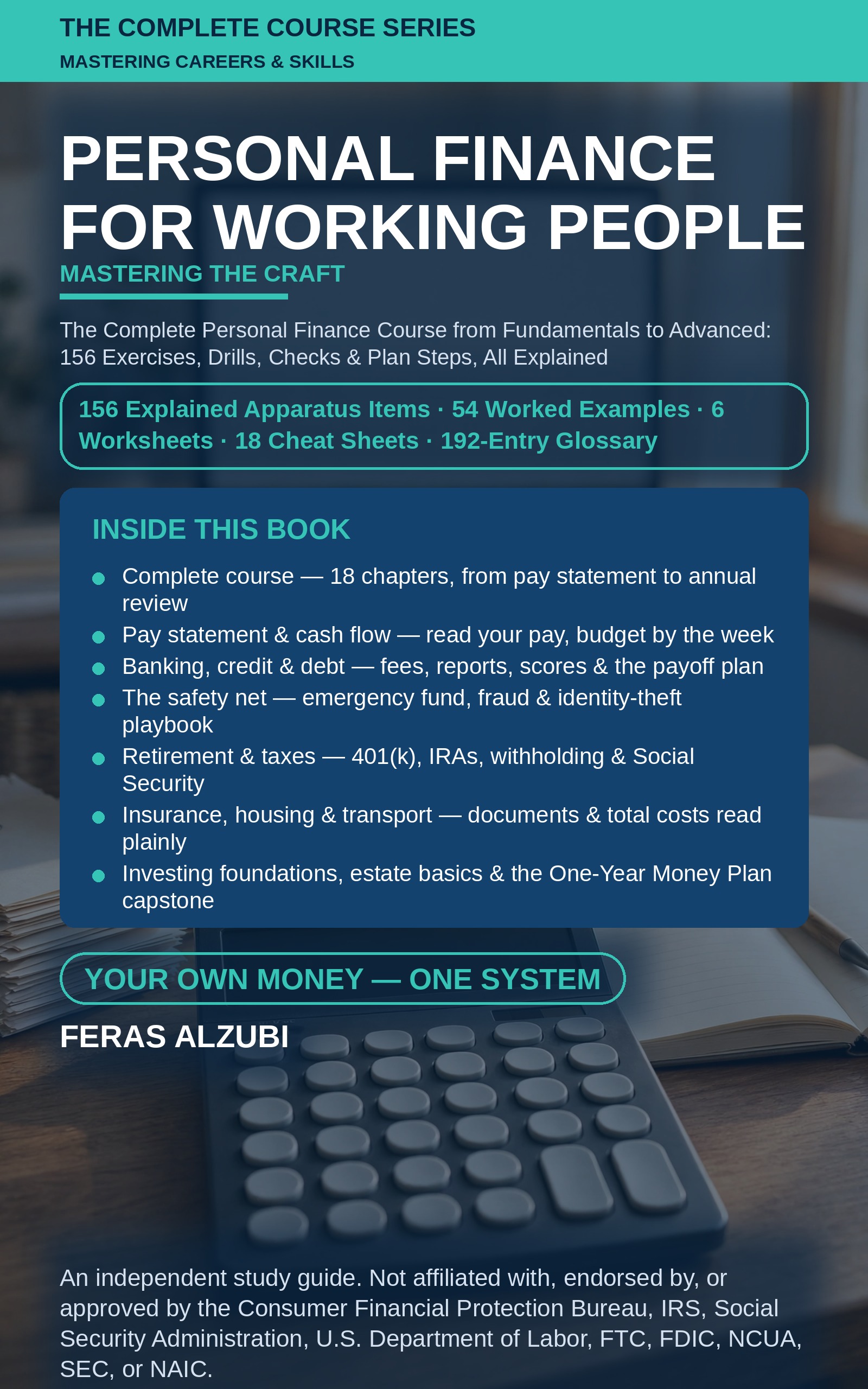
The Complete Personal Finance Course from Fundamentals to Advanced: 156 Exercises, Drills, Checks & Plan Steps, All Explained
The Buy button takes you to this book's secure Payhip page, where you can read the free first-chapter sample, pay, and download the EPUB instantly.
Personal Finance for Working People: Mastering the Craft — The Complete Personal Finance Course from Fundamentals to Advanced: 156 Exercises, Drills, Checks & Plan Steps, All Explained
What this book teaches. The complete course in running a working household's money as one system, taught from the reader's own pay, accounts, debts, and documents, with no prior knowledge assumed beyond ordinary working life. It opens with the Money-Health Check: 24 checks in four domains, each check carrying an explained routing note that names what the answer usually means and the chapter or chapters it routes to. The check computes no total score; its work is routing, and the reader returns to it in the capstone and compares answers item by item and domain by domain. The 18 chapters stand in six parts. Part I, Know Your Money: Your Pay Statement, Decoded; Cash Flow First: The Weekly Budget; and Budget Systems That Fit a Paycheck. Part II, Banking, Credit, and Debt: Bank Accounts, Cards, and the Fees That Leak; Credit Reports and Credit Scores, Demystified; Debt in Full: Cards, Cars, Student Loans, and the Mortgage; and The Payoff Plan: Avalanche, Snowball, and Your Numbers. Part III, The Safety Net: The Emergency Fund: Your First Line of Defense; and Fraud, Scams, and Identity Theft: The Worker's Playbook. Part IV, Retirement and Taxes as a Worker: Retirement at Work: The 401(k) and Its Cousins; IRAs and Saving Beyond the Workplace; Taxes as a Worker: Withholding, Filing, and the Standard Deduction; and Social Security: What You Are Building With Every Paycheck. Part V, Protection and the Big Decisions: Insurance a Worker Meets: Health, Disability, Life, Auto, Home; Housing and Transport: The Two Big Monthly Decisions; and Investing Foundations: Risk, Diversification, and Your First Accounts. Part VI, Household and the Long View: Money With a Partner and Family; and Estate Basics and the Annual Money Review. One fictional household carries the worked arithmetic from Chapter 1 to the capstone, so the numbers met in one chapter are the same numbers in every other: Alex Rivera and Sam Rivera, a salaried worker and a worker with variable part-time and gig income, whose pay statement, monthly position, debts, and essential expenses are worked end to end. The household is a teaching specimen; every figure attached to it is illustrative, labeled as illustrative where it stands. The book closes with the capstone, Build Your One-Year Money Plan: 12 plan steps, each with a worked key on the specimen household, that assemble the chapters into one plan, closing with the annual-review date set. The back matter prints three action paths as route maps through the book: the 30-Day Starter Path, the 90-Day System Path, and the Annual Path. Investing is taught to foundation level only, in Chapter 16: what investing is, that all investments involve risk, diversification, asset allocation, and how the investment menus inside workplace plans and IRAs work at the description level. Security selection, portfolio construction, withdrawal strategy, and retirement-income planning are not taught here; they belong to the companion book Investing & Retirement, and this book signposts them and stops.
Who it is for. The working reader — hourly, salaried, or mixed-income — who wants the whole of household money in one place rather than in fragments: pay, cash flow, banking, credit, debt, the safety net, retirement at work, taxes, insurance, housing and transport, and the annual review. It assumes no prior knowledge beyond ordinary working life, and it is written for the reader's own household: every exercise works a situation from working life and routes what depends on the reader's own plan document, policy, account agreement, or state rule back to that document.
What's inside (every count verified against the actual book):
Read the first chapter free — the sample on this page is Chapter 1 of this book, exactly as it appears in the full edition.
From the Mastering Careers & Skills library — complete A-to-Z professional teaching books for careers, trades, and certifications.
This book teaches how personal money systems work. It is general financial education, not personalized financial, tax, investment, insurance, or legal advice, and reading it does not create an adviser-client relationship with its author or publisher. It teaches categories and mechanics, and it names no bank, account, card, fund, insurer, platform, or provider as a recommendation. It makes no promise about any reader's income, returns, savings, debts, credit, or retirement, and it predicts no outcome for any reader: where the book works an example to a result, the result belongs to that example's stated numbers only. Every worked example uses illustrative figures, labeled where it stands; the specimen household and all figures drawn from it are fictional teaching figures and are not presented as typical, average, or recommended. Federal tax figures in this book are stamped to tax year 2026, and retirement-plan limits are stamped to year 2026, each with its source named where it stands. This book is not affiliated with, sponsored by, or endorsed by the Consumer Financial Protection Bureau, the Internal Revenue Service, the Social Security Administration, the U.S. Department of Labor, the Federal Trade Commission, the Federal Deposit Insurance Corporation, the National Credit Union Administration, the U.S. Securities and Exchange Commission, the U.S. Department of Education, the Centers for Medicare & Medicaid Services, the U.S. Department of Health and Human Services, or the National Association of Insurance Commissioners. Agency and institution names appear only to identify the published public guidance this book teaches from, which is cited throughout.
Refunds: Please read the free sample chapter before you buy. This is a digital ebook, delivered instantly by download. If the file is defective, or you cannot open or download it and we cannot fix the problem, you will receive a full refund — email us within 14 days of purchase. Because the book is delivered instantly as a downloadable file, all other sales are final.
How to read this book (EPUB format): After checkout, download the EPUB file, then open it in any free ebook reader app. On iPhone or iPad: Apple Books — it is already on your device. On Android phones and tablets: Google Play Books (free: https://play.google.com/store/apps/details?id=com.google.android.apps.books) — upload the file in the app — or ReadEra (free). On a Windows or Mac computer: Thorium Reader (free: https://thorium.edrlab.org) or Adobe Digital Editions (free). On Kindle: use Amazon's free Send to Kindle (https://www.amazon.com/sendtokindle) to add the file to your Kindle library.